Home · Coffee export
Export · Sul de Minas CoffeeCoffee from Juruaia to the world.
High-altitude Arabica from the Sul de Minas region, 15 km from Guaxupé, home of the world's largest coffee cooperative. Traceable lots, 84+ SCA specialty coffees and Café da Lee under its own brand or as private label.
Juruaia (MG) produced 7,488 tonnes of Arabica coffee in 2025 (IBGE) and lies 15 km from Guaxupé, a municipality that exported US$ 1 billion in coffee between January and May 2025 alone, and about 160 km from the Porto Seco Sul de Minas dry port in Varginha. Brazil set a record for coffee export revenue in 2025: US$ 15.59 billion, with differentiated coffees averaging US$ 432.78 per bag. Ateliê da Lee and Grupo Eliana connect international buyers with selected lots from the region, with end-to-end traceability, and offer Café da Lee (84+ SCA) under its own brand or as private label.
Brazilian coffee by the numbers.
See data
| Germany | 13,5 |
| USA | 13,4 |
| Italy | 7,8 |
| EU (bloc) | 43,0 |
See data
| 2024/25 | 323,13 |
| 2025/26 | 379,48 |
| Specialty 2025 | 432,78 |
Sources: Cecafé via Poder360 (Jan 2026), AgFeed (Jan 2026) and AgFeed (Jul 2026); Diário do Comércio (Jun 2025); Cooxupé/CNN Brasil (Mar 2026); Notícias Agrícolas (Jul 2026). Italy: 3.14 million bags out of 40.04 million (our own calculation).
The terroir of Juruaia and Sul de Minas.
What buyers need to know about the region the coffee comes from.
| Feature | Juruaia and Sul de Minas |
|---|---|
| Region | South/Southwest Minas Gerais, in the Guaxupé immediate region. Juruaia sits at 877 m above sea level (City Hall); the region's coffee farms range from 900 to 1,300 m (Sebrae, 2025). |
| Species | 100% Arabica in Juruaia (IBGE, PAM 2025): 4,800 hectares harvested and 7,488 tonnes, about 26 bags per hectare, 8.6% above the Minas Gerais average. |
| Varieties | Mostly the Catuaí group, well adapted to the region, plus Mundo Novo and other Arabica cultivars (Sebrae, 2025). |
| Processing | Dry process (natural) and wet process (pulped natural); hand-picked on mountain slopes and mechanized harvesting on flat areas. |
| Harvest | From May to September; in 2026, the Sul de Minas harvest picked up from mid-May. |
| Sensory profile | Sweet flavor, velvety body, balanced acidity and complex notes, with the chocolate, caramel and nuts typical of the region's naturals. |
| Producers | About 80% are smallholders in Sul de Minas; 97.6% of Cooxupé members are micro or small producers. |
| Recognition | At Cup of Excellence Brazil 2025, the record-setting auction lot came from Três Pontas (Sul de Minas) at US$ 65.10 per pound; in Cooxupé's Especialíssimo 2025 competition, the top 50 lots scored above 83 SCA points. |
| Geographical indication | There is no "Sul de Minas" coffee GI registered with INPI as of 2026. Traceability by lot, producer and coordinates takes the place of an origin seal in negotiations. |
Sources: Sebrae, Diagnóstico Sul de Minas Café Arábica (Jan 2026), IBGE, Diário do Comércio (Nov 2025), Compre Rural (Dec 2025), Notícias Agrícolas (Nov 2025), CNN Brasil (Mar 2026).
Three ways to buy coffee from Juruaia.
Specialty green coffee
Curation of 84+ SCA lots from smallholders in Juruaia and the surrounding region, with cupping, grading report, samples and traceability by lot, producer, altitude, variety and process.
Café da Lee
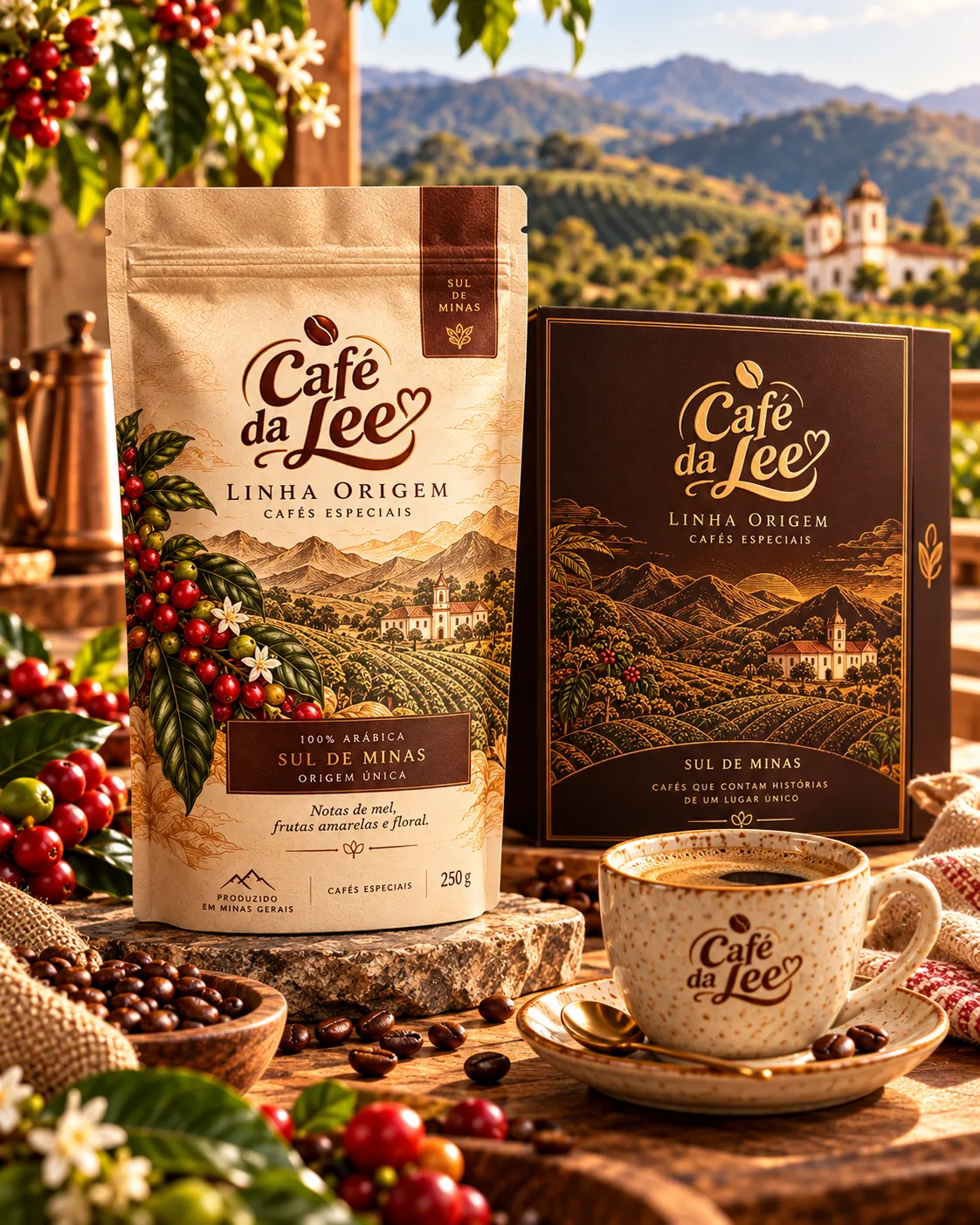
Brazil's first dark coffee, roasted and packed: whole bean, ground, drip bags and capsules, for delis, coffee shops, hotels and retail chains abroad.
Your brand, our coffee
Blends and microlots developed for your brand, with a tailored sensory profile, roast, packaging and labeling in your market's language.
Volumes, Incoterms (FOB Santos is market practice), lead times and prices are set by contract, depending on the crop and lot availability.
From the coffee farm to your port.
Brief and samples
You tell us your market, volume, cup profile and required certifications. We send samples with a technical data sheet and cupping report.
Contract
Agreement on lot, price, Incoterm (FOB Santos, CIF or FCA), packaging (jute bags, big bags or GrainPro) and shipping schedule.
Grading and preparation
Re-processing, official grading (type, screen size and cup quality) and lot preparation in a regional warehouse.
Documents
DU-E on the Portal Único Siscomex, ICO certificate of origin, MAPA phytosanitary certificate when the country requires it, commercial invoice, packing list and B/L.
Shipment
Road transport to the Porto Seco Sul de Minas dry port (Varginha) or directly to the Port of Santos, which handles 78.7% of Brazil's coffee exports.
Tracking and after-sales
Lot data, geolocation of the plots and EUDR compliance documentation, plus tracking until arrival.
Coffee export checklist.
| Step | Requirement | Responsible party |
|---|---|---|
| Registration | General Classification Register at MAPA (CGC/MAPA) and a gov.br business account | Exporter |
| Registration | Radar Siscomex at the Receita Federal (Federal Revenue Service) | Exporter |
| Customs clearance | Single Export Declaration (DU-E) and LPCO on the Portal Único Siscomex | Exporter or customs broker |
| Origin | ICO certificate of origin: Cecafé or CNC for green coffee; ABIC and Coffee Trade Centers for roasted and ground coffee. Guaxupé/Japy, Varginha and Poços de Caldas are listed as ICO-registered locations | Certifying agent |
| Plant health | MAPA phytosanitary or sanitary certificate, when the importing country requires it (free of charge, requested online) | MAPA / Vigiagro |
| United States | FDA Prior Notice before arrival; coffee exempt from Section 301 surcharges since July 2026 | Importer / exporter |
| European Union | EUDR: geolocation of the plots, traceable lot, proof of no deforestation after December 31, 2020 and legality (CAR rural environmental registry, environmental and labor compliance). Applies from December 30, 2026 for large and medium-sized companies and from June 30, 2027 for micro and small companies. Brazil is classified as standard risk | Producer, exporter and importer |
| Agreements | Mercosur–EU provisionally applied since May 1, 2026; Mercosur–EFTA in force with Iceland (October 1, 2026) and Norway (November 1, 2026), with tariff reductions for roasted coffee | — |
Sources: Gov.br/MAPA (Aug 2026), ICO, certifying agents and ports 2025/26, Agrolink (Aug 2026), Notícias Agrícolas (Jul 2026), European Commission, Movimento Econômico (Oct 2026), Notícias Agrícolas (Jan 2026).
Infrastructure next to Juruaia.
Cooxupé
Revenue of R$ 16.99 billion in 2025, 6.07 million bags received and 4.8 million exported to 50 countries; its specialty arm (SMC) exported 168,000 bags to 24 countries.
Porto Seco Sul de Minas
More than R$ 70 million invested in coffee facilities, a climate-controlled warehouse at 18 °C and 60% humidity, and capacity expanding to 2 million bags; about 30 million bags a year pass through Varginha.
Port of Santos
Brazil's main coffee export gateway: 78.7% of exports in 2025.
Sources: CNN Brasil (Mar 2026), Diário do Comércio (Sep 2026), Notícias Agrícolas (Jan 2026). Approximate road distances.
Request samples and a quote.
Tell us your market and the type of coffee: the message arrives ready on our WhatsApp, with a protocol number. We serve you in Portuguese, English and Spanish.
Coffee export FAQ
Can I buy coffee from Juruaia for export?
Yes. Grupo Eliana connects international buyers with selected lots from Juruaia and Sul de Minas (84+ SCA, traceable) and offers roasted Café da Lee under its own brand or as private label. Contact us on WhatsApp (11) 99992-4741.
What is Juruaia coffee like?
High-altitude Arabica, 100% Arabica in the municipality, mostly Catuaí and Mundo Novo, natural and pulped natural processes, harvest from May to September and a sweet profile with a velvety body and notes of chocolate, caramel and nuts.
What documents are needed to export coffee from Brazil?
CGC/MAPA registration, Radar Siscomex, DU-E on the Portal Único, ICO certificate of origin, phytosanitary certificate when required, commercial invoice, packing list and B/L. For the European Union, EUDR compliance from December 30, 2026.
Does Brazilian coffee pay an extra tariff in the United States?
No. Since July 2026, the USTR has exempted Brazilian coffee in all its forms from Section 301 surcharges.
Through which port is the region's coffee exported?
Mainly through the Port of Santos, which handled 78.7% of Brazil's coffee exports in 2025, supported by the Porto Seco Sul de Minas dry port in Varginha.